The Best No-Knead Bread
A crusty, bakery-style loaf with a crackling crust and a chewy, open crumb, made from four ingredients and about five minutes of actual work.
- Prep
- 10 min
- Cook
- 45 min
- Rise
- 13 hr
- Total
- 13 hr 55 min
- Makes
- 1 loaf
Ingredients
Missing something? Substitutes for bread flour, yeast.
Method
Ingredient amounts are scaled. Amounts, pan sizes and times written in the steps are for the original recipe.
Mix
Stir the flour, salt and yeast together in a large bowl. Add the water and mix with a spatula or your hand until no dry flour remains, about 30 seconds. The dough will be shaggy and sticky.
Rise
Cover the bowl with plastic wrap or a plate and leave it at room temperature for 12 to 18 hours. The dough is ready when it has doubled, the surface is dotted with bubbles and it jiggles when you shake the bowl.
Shape
Scrape the dough onto a well-floured surface. With floured hands, fold the edges into the center, working around the dough 4 or 5 times, to make a rough ball. Turn it seam side down onto a sheet of parchment paper, dust the top with flour and cover it with a towel.
Heat the pot
Put a 4- to 6-quart Dutch oven with its lid in the oven and heat the oven to 450°F (230°C). Let the pot heat for 30 to 45 minutes while the dough rests.
Bake
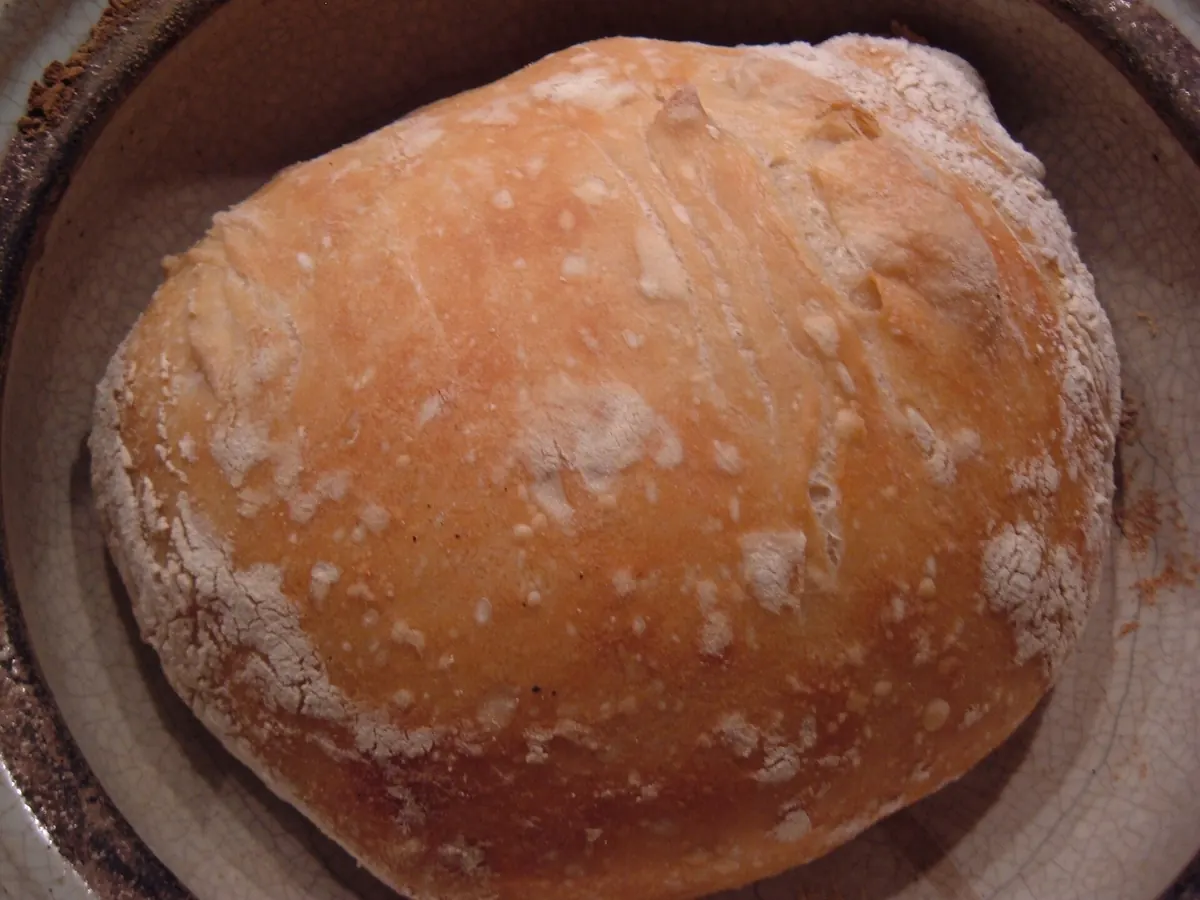
Carefully take the hot pot out of the oven. Lift the dough by the parchment paper and lower it in, paper and all. Cover and bake for 30 minutes. Remove the lid and bake for 12 to 18 minutes more, until the crust is a deep golden brown.
Cool
Lift the loaf onto a rack and cool for at least 1 hour before slicing. The inside is still setting, and bread cut hot turns gummy.
Why this is the one
Time does the kneading
Over 12 hours or more, a wet dough develops gluten on its own. The long, slow rise with a tiny amount of yeast also builds a depth of flavor that a quick loaf never has.
A wet dough
The high proportion of water turns to steam inside the loaf, which opens up the large, irregular holes and gives the crumb its chew.
A preheated Dutch oven
A hot, covered pot traps the steam coming off the dough, just as a professional bread oven does. The loaf expands fully, and the crust bakes thin, crisp and deeply browned.
Tips
- Mix the dough after dinner and bake in the morning, or mix it at breakfast for bread with dinner. In a warm kitchen the dough is ready in 12 hours; in a cool one it needs closer to 18.
- Check that the knob on your pot lid is oven-safe to 450°F (230°C). If it is not, unscrew it and plug the hole with a ball of foil.
- For a flavored loaf, stir in a cup of shredded cheese, chopped olives or a tablespoon of chopped rosemary when you mix the dough.
Make ahead and storage
Keep the loaf cut side down on a board, uncovered, for 2 days, which keeps the crust crisp. After that, bag it. Freeze sliced for up to 3 months and toast from frozen. Refresh a whole loaf at 350°F (175°C) for 10 minutes.
Questions
Can I make no-knead bread without a Dutch oven?
Any heavy, oven-safe pot with a lid works. Without one, bake the loaf on a preheated baking sheet with a pan of hot water on the rack below. The crust will be a little less crisp.
Can I use all-purpose flour?
Yes, in the same weight. The dough will be slightly stickier and the loaf a little less chewy, so hold back a tablespoon of the water.
Can I use active dry yeast?
Yes. Use a slightly heaped ¼ teaspoon. With a rise this long there is no need to dissolve it first.